


The Devils
October 13th, 2026
MOVIE: THE DEVILS
STARRING: OLIVER REED, VANESSA REDGRAVE, GEMMA JONES, MICHAEL GOTHARD
DIRECTED BY: KEN RUSSELL
AMovieGuy.com’s RATING: 4 STARS (Out of 4)
RATED: NC-17
RUN TIME: 111 MINUTES
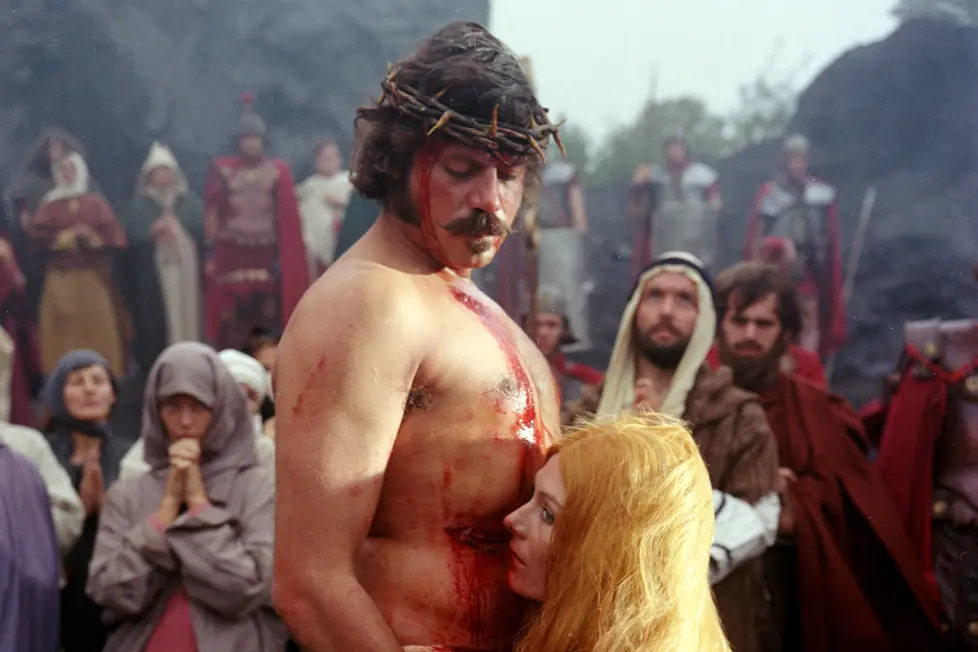
Time has a fascinating impact on cinema. When Ken Russell’s The Devils screened at the 1971 Venice Film Festival, the Vatican called for its screenings to be canceled. Although the film was shown to members of the press, a planned public screening was canceled amid fears of protests. Even Roger Ebert, who was often willing to embrace provocative art, gave the film a rare zero-star review. I often wonder how Ebert might respond to the film today, especially since The Devils has not only aged remarkably well but also explores themes of religion, scapegoating, persecution, and politics that feel more relevant than ever. Now, in 2026, the film is returning to theaters in a glorious 4K restoration. Having seen it for the first time, I can unequivocally say that it remains provocative, bombastic, and a spectacular work of horror cinema.
Summarizing the plot hardly does justice to the experience of watching this film, but I’ll try my best. The story begins in the walled French city of Loudun, where Sister Jeanne (Vanessa Redgrave), the mother superior of a convent, gazes upon Father Urbain Grandier (Oliver Reed), a charismatic priest who has become notorious for his sexual relationships and abuse of power. Jeanne is consumed by her desire for Grandier, and her obsession threatens to unravel her faith. Meanwhile, political forces are conspiring against the priest. Cardinal Richelieu (Christopher Logue), acting in the interests of the French crown, sees an opportunity to consolidate royal power by dismantling Loudun’s defenses and influence. Grandier’s relationship with Madeleine (Gemma Jones), combined with the hysteria surrounding the convent, provides his enemies with the means to accuse him of witchcraft and destroy him.
That is the story in a nutshell, but there is so much more at play. Adapted by Russell from John Whiting’s stage play and Aldous Huxley’s nonfiction book The Devils of Loudun, the film begins as an examination of religious hypocrisy before becoming a chilling portrait of how power is sought, wielded, and abused at the expense of the vulnerable. Persecution becomes a convenient means of eliminating an enemy, while religious hysteria provides the perfect cover for political ambition.
What Russell has crafted is a remarkably timeless film, one that feels like a microcosm of American politics today. Religion is weaponized, leaders exploit their followers, and those who claim to uphold morality are often the first to abandon it when power is at stake. The film’s central theme is scapegoating: identify an enemy, convince the public that this person represents a threat, and use the resulting outrage to consolidate power. Once the target has been eliminated, the people responsible for the persecution are free to commit even greater atrocities themselves.
Upon its original release, The Devils became notorious for its graphic nudity, sexual imagery, and desecration of religious iconography. Its controversial content provoked fierce backlash and censorship, and the film was originally released with an X rating in both the United Kingdom and the United States. The newly restored version has received an NC-17 rating in the U.S. Watching it today, I find its audacity remarkable. Russell does not simply shock audiences for the sake of shocking them; he uses grotesque imagery and religious provocation to expose the darkness that can emerge when faith becomes an instrument of control.
Replace the religious iconography with statues of Trump, and you have a film that feels uncomfortably close to the spectacle of his most devoted political followers. Just this past week, a woman protesting at one of Trump’s rallies was punched by another attendee. Rather than focusing on the violence against her, Trump mocked her appearance from the stage. Meanwhile, his remarks about the possibility of Los Angeles or San Diego being targeted by Iran have added another disturbing dimension to his political rhetoric. When followers cheer on cruelty and embrace a leader’s most inflammatory statements, it is worth asking what principles they are actually defending and whom they ultimately serve.
That is the tragedy at the heart of The Devils. The nuns become instruments in a campaign to destroy Grandier, their accusations serving the interests of men who are more concerned with political control than spiritual truth. The ensuing show trial becomes a spectacle of manufactured justice, and the destruction of Grandier ultimately accompanies the destruction of the very community his enemies claim to be protecting. The people who believe they are serving a righteous cause become participants in their own oppression.
Beyond its cultural and political relevance, The Devils is a spectacularly crafted film. The production design and costumes are extraordinary, creating a world that feels both historically grounded and nightmarishly surreal. David Watkin’s cinematography deserves a coffee-table book of its own, while the stark, imposing sets designed by Derek Jarman turn the architecture into an extension of the film’s oppressive atmosphere. Oliver Reed delivers a performance brimming with his trademark theatrical energy, while Vanessa Redgrave portrays Sister Jeanne’s unraveling with astonishing intensity, making her transformation into a figure of obsession and hysteria both disturbing and mesmerizing.
The film’s return also brings to mind the recent reconstruction of Tinto Brass’s Caligula, another controversial historical epic about a narcissistic ruler, the corruption of power, and the hypocrites who seek to replace one tyrant only to pursue their own ambitions. Both films demonstrate how stories of political and moral decay can transcend their historical settings, revealing uncomfortable truths about the societies that produce them.
The Devils may have been condemned, censored, and pushed to the margins of cinema history in 1971, but its power has only grown with time. In 2026, it stands as one of the greatest films I have ever witnessed. It is a furious, visually astonishing, and deeply unsettling work that challenges viewers to confront the relationship between faith, fanaticism, and political power.
You do not simply watch The Devils. You experience it.
4 STARS
THE DEVILS IS PLAYING IN SELECT THEATERS FOR ONE WEEK ONLY STARTING FRIDAY, OCTOBER 16, 2026.
Written by: Leo Brady